
Holding a Position
Accumulating Fees
- Holding Fee
- The longer you hold a position, the more fees accumulate.
- Charged only when you close the position.
- Funding Fee
- Paid or earned depending on whether you hold a Long or Short position.
- When Long OI > Short OI → Longs pay, Shorts earn.
- When Long OI < Short OI → Longs earn, Shorts pay.
On the platform, Holding Fee and Funding Fee are combined and displayed simply as Funding Fee.
See Holding & Funding Fees for detailed calculations.
Managing Collateral
- You can add collateral to an open position, and you can remove it, on every pair including the high-leverage ones.
- Removing collateral is rejected if it would leave the position above the pair's maximum leverage, beyond the take-profit cap, or immediately liquidatable.
- On the high-leverage pairs (500x / 750x / 1001x), adding or removing collateral may not bring effective leverage to 485x or below — that would take the position out of high-leverage mode.
- All trade-related fees are deducted from collateral.
- Ensure you set aside enough to cover fees and reduce the risk of liquidation.
Managing Take Profit / Stop Loss (TP/SL)
- TP and SL are independent orders sitting on the position. You can add, edit, and cancel them at any time, individually or all at once.
- A position can carry several TP and SL orders — each with its own trigger price and its own share of the position — so you can scale out rather than closing in one go.
- Adding to a position does not disturb the TP/SL orders already on it.
Minimum Trade Duration
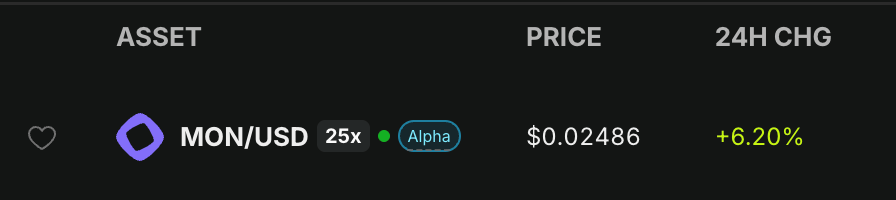
On Alpha-tagged pairs, a position above $40,000 notional must be held for a minimum period — currently 3 minutes on every pair that has the rule — and take profit does not fire during that window. The pairs carrying the rule today are MON/USD, DOGE/USD, LIT/USD, ZEC/USD and XMR/USD.
Because positions on the same pair are merged, the lock attaches to the whole position. Adding a qualifying leg to a position you could already have closed locks all of it until the new leg's minimum period expires.
This is because sophisticated actors can attempt to influence external order books and oracle prices. Since LeverUp uses Pyth as its oracle, this protection is necessary.
The rule mainly impacts high-frequency scalping behavior and does not affect normal traders.
Alpha-pair slippage
Slippage on Alpha-tagged pairs is set per pair and is currently between 0.05% and 0.15%. The figure for the pair you are trading is shown in the order ticket.