
Tokenomics
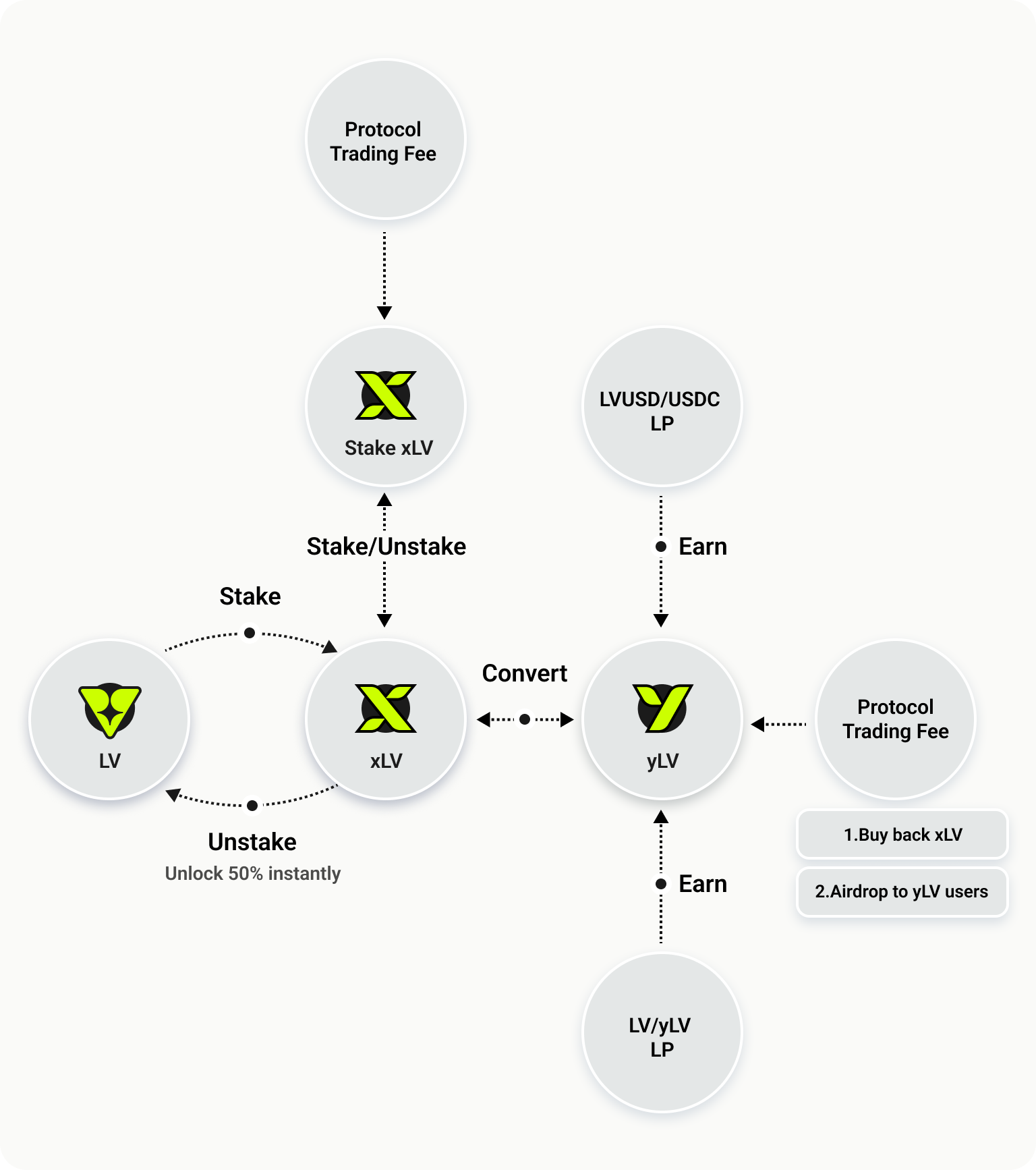
To strengthen trader incentives, LeverUp introduces a dedicated Token Design mechanism.
Each epoch, the protocol distributes token emissions directly to traders as rewards, while simultaneously using 100% of protocol fees for buybacks to preserve intrinsic token value.
Beyond short-term incentives, the design is structured to reward long-term holders and loyal users, aligning token value with sustained participation and ecosystem growth.
A Unified Token, Multiple Forms
At its core, the system revolves around a single token: $LV
This token can exist in multiple forms depending on its usage within the ecosystem, but fundamentally represents the same underlying value
 LV
LV
LeverUp Native Token
 xLV
xLV
Staked version of LV with rebasing design
 yLV
yLV
Liquid wrapped version of xLV
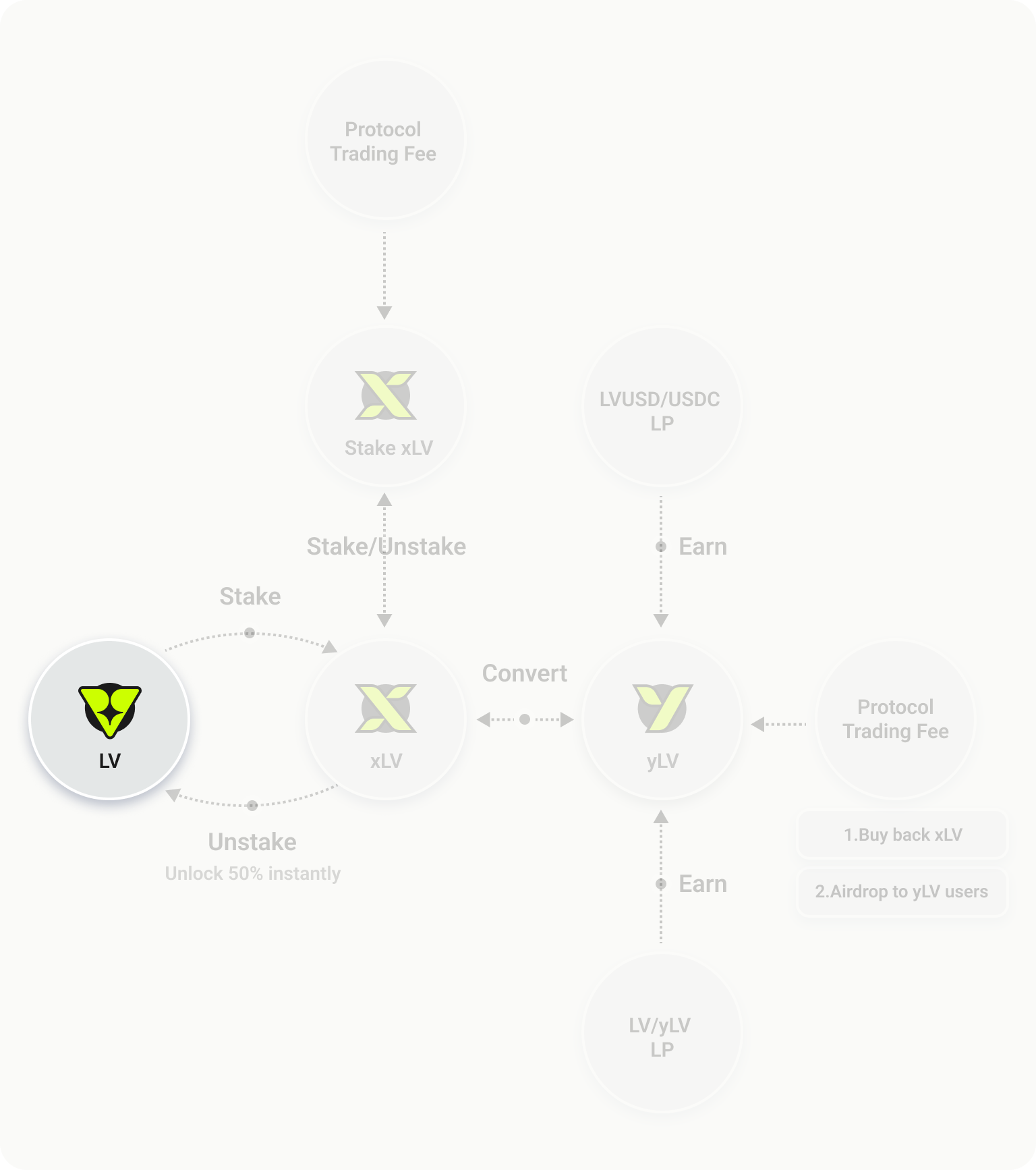
LV
LV is the native token for LeverUp traders
How to Earn LV
- Trading
- Points are awarded based on trading volume, PnL, and related performance metrics.
- Referrals
xLV
xLV Exit Mechanism
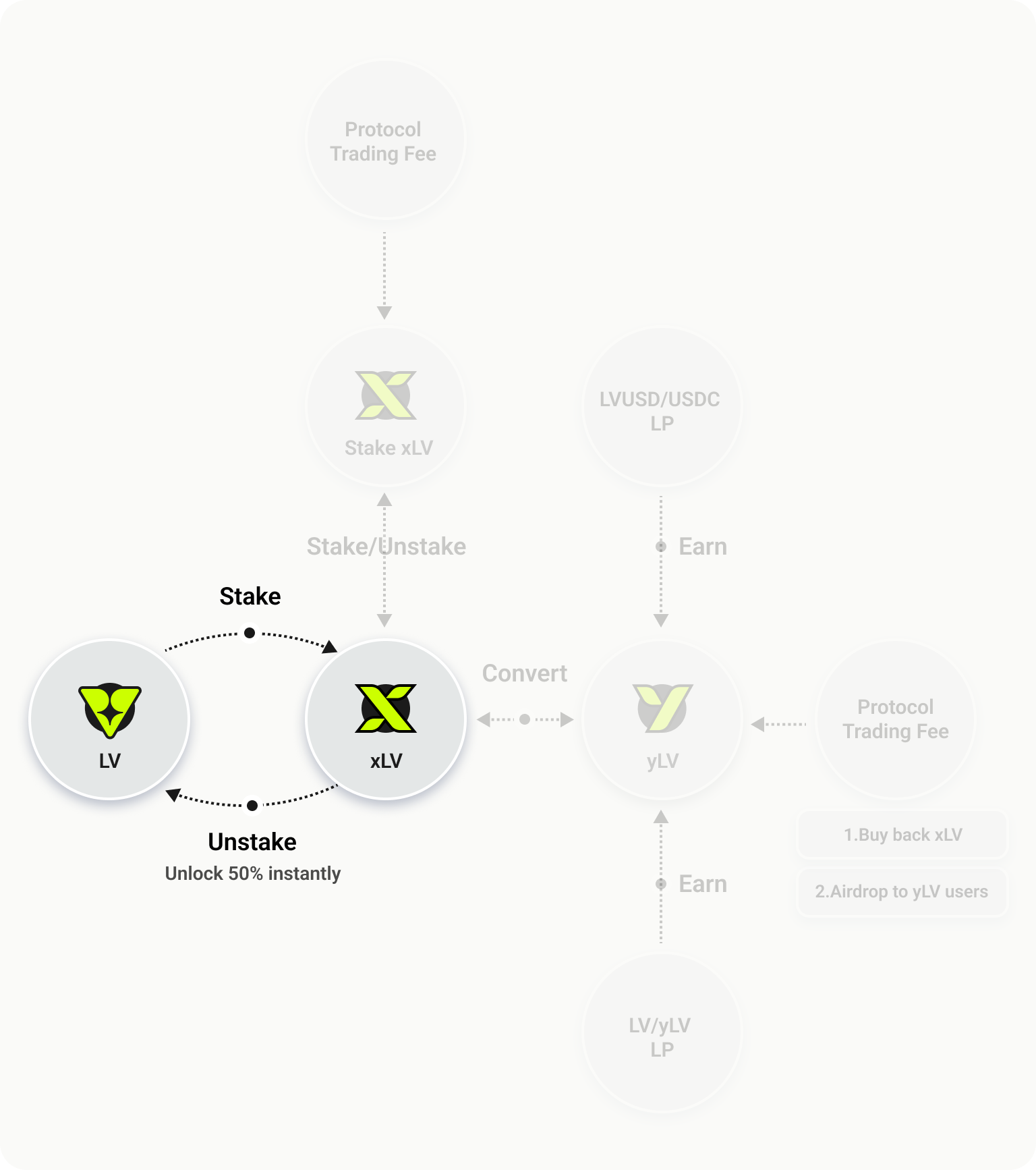
LeverUp introduces exit model designed to align incentives without relying on rigid lock-ups.
When a user exits their xLV position early, the portion of tokens forfeited is redistributed entirely to existing xLV stakers on a pro-rata basis.
This mechanism establishes a flywheel of loyalty and rewards, ensuring that:
- Incentives grow with protocol scale
- Stayers are rewarded without lock-up constraints
- No external wrappers are required
To further enhance flexibility, yLV is introduced as a liquid representation of xLV, offering users a wrapper-free way to maintain liquidity while participating.
Exit Rebase
- Any xLV tokens forfeited due to instant exits will be streamed to active stakers.
- Rewards are claimable in proportion to xLV staker positions after each epoch transition.
- This functions both as dilution protection and as an additional incentive layer for committed participants.
By discouraging exits and redistributing penalties(50%) to long-term holders, the system directly rewards loyalty and reinforces stability.
Unstaking staked xLV
Based on the design of socialized loss, xLV stakers play a role in ensuring the protocol remains functional and stable
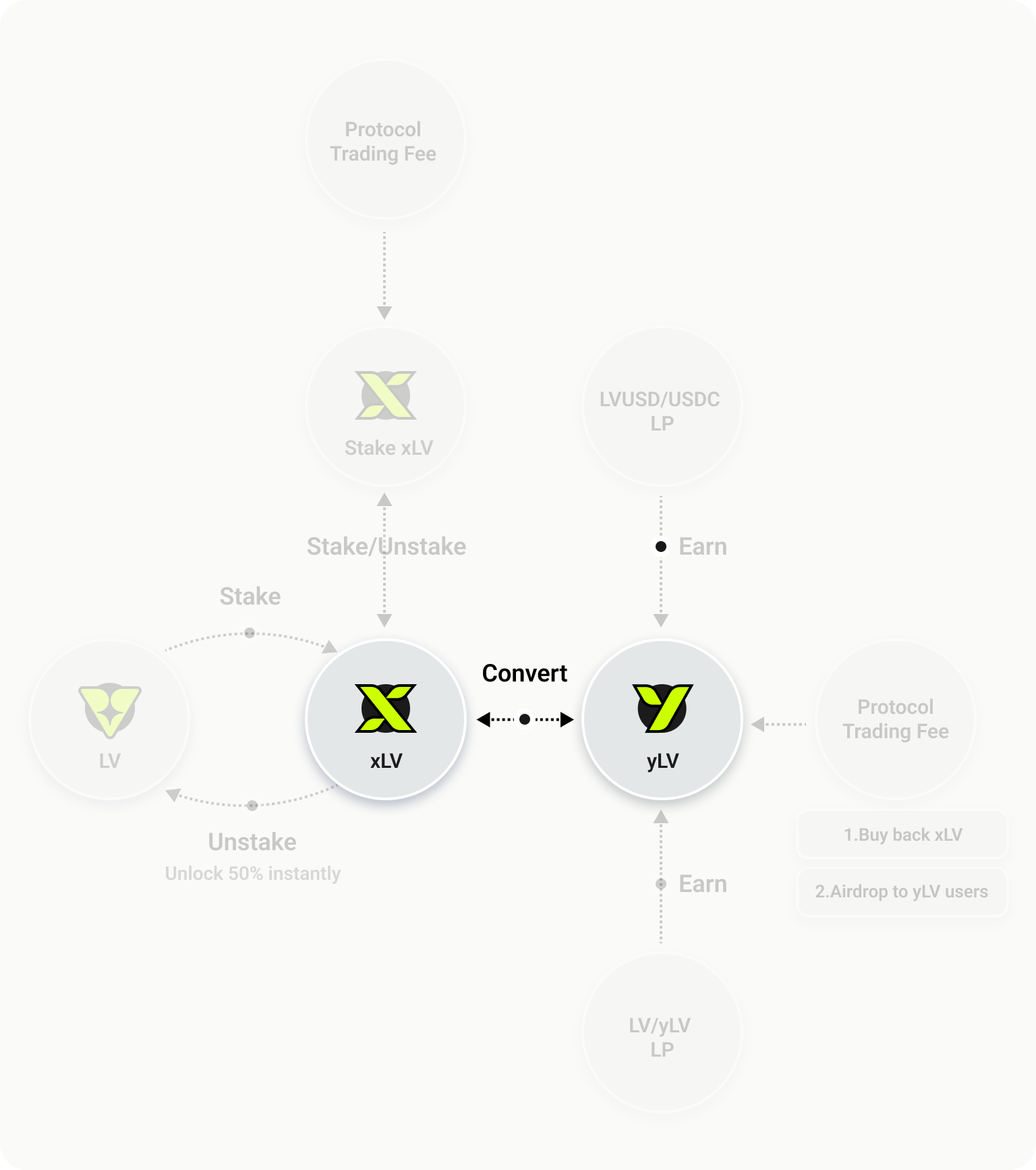
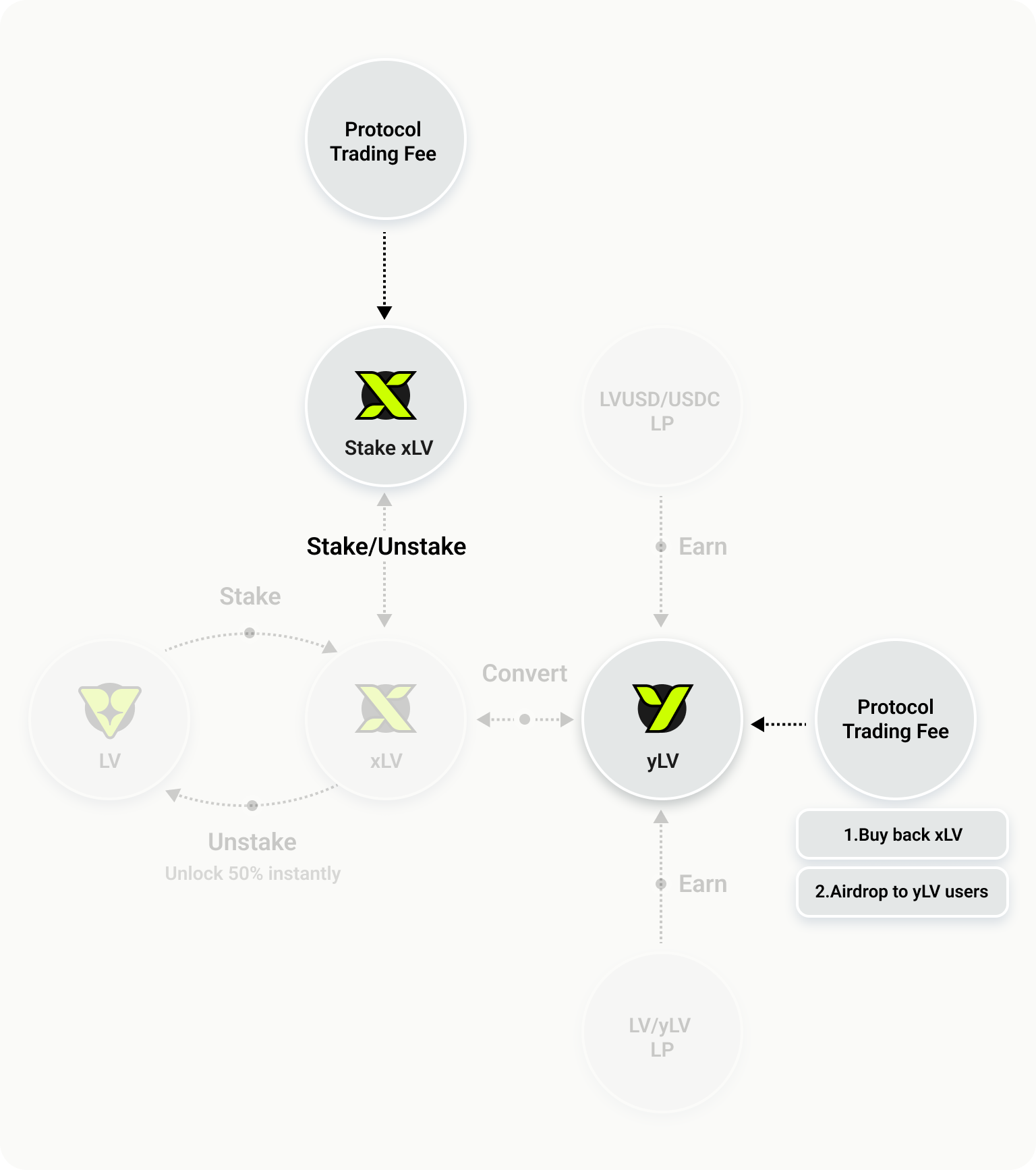
xLV <-> yLV
Since xLV is a rebasing token, to further enhance flexibility, yLV is introduced as a liquid representation of xLV, offering users a wrapper-free way to maintain liquidity while participating
The yLV -> xLV convert rate will be based on the xLV amount in yLV vault, in general, protocol fees buy back xLV, which results in a higher convert rate, that is to say, holding yLV will automatically increase the position of xLV
Protocol Fee Incentive
Protocol fee incentives are weighted by the ratio between staked xLV and xLV in the yLV vault
- Staked xLV users receive USDC directly from protocol fees
- yLV users receive xLV — the protocol buys back $LV and stakes it into xLV as incentives
LV Tokenomics
| Amount | Alloc % | Note | |
|---|---|---|---|
| LV Genesis Airdrop(S0,S1) | 100,000,000 | 10% | S0 and S1 will be the only 2 seasons for genesis airdrop |
| Trader Incentives Emission | 600,000,000 | 60% | Bonding Curve Vesting 0% unlocked at TGE, unlocked weekly after Season 1 by epoch emission algorithm |
| Liquidity | 50,000,000 | 5% | 100% unlocked at TGE |
| Team & Core Contributor | 100,000,000 | 10% | 6 months cliff 12 months vesting |
| Public Sale | 10,000,000 | 1% | 100% unlocked at TGE |
| Treasury | 140,000,000 | 14% | 20.7% unlocked at TGE remaining 79.3% vesting after a 6-month cliff, then monthly linear over 12 months |
Initial Supply: 90,000,000
Total Supply: 1,000,000,000
$LV at TGE: 9%
Which allocations are paid in xLV
Allocations in xLV: Genesis Season 1 / Team & Core Contributor
Allocations in LV: Public Sale/Liquidity/Treasury/Trader Incentives Emission
Emission
Weekly emission of $LV will be distributed to traders based on $LV Point
| Epoch | $LV Emission | Note |
|---|---|---|
| Epoch 0 | 3,744,000 | |
| Epoch 1 | 4,564,685 | 20% Increase |
| Epoch 2 | 5,117,559 | 10% Increase |
| Epoch 3 | 5,695,950 | 9% Increase |
| Epoch 4 | 4,894,743 | 16% decrease |
| Epoch 5 | 3,742,046 | 25% decrease |
| Epoch N | / | 1% weekly decay |
Total supply asymptotically approaches 1B tokens
Elastic Emissions
Emissions may be adjusted by up to ±35% per epoch based on protocol fee in order to maintain sustainable inflation
- Increase in Emissions: When protocol fees consistently exceed emissions over multiple epochs, or when revenue growth catalysts are expected.
- Decrease in Emissions: When protocol fees fall significantly below emissions over multiple epochs, or when revenue decline catalysts are anticipated.